The NewSpace Revolution: How KSF Space Empowers KSA Universities to Lead in CubeSat KSA Technology and STEM Innovation
July 2, 2026 2026-07-02 15:52The NewSpace Revolution: How KSF Space Empowers KSA Universities to Lead in CubeSat KSA Technology and STEM Innovation
The NewSpace Revolution: How KSF Space Empowers KSA Universities to Lead in CubeSat KSA Technology and STEM Innovation
The global space economy is undergoing a massive shift. High-barrier, billion-dollar space missions have evolved into an agile, accessible playground known as the “NewSpace” era. At the absolute forefront of this transformation is the rapid adoption of small satellite technology. For the Kingdom of Saudi Arabia, this evolution aligns perfectly with the ambitious mandates of Vision 2030, which prioritizes technological localization, local talent development, and economic diversification.
To achieve these national milestones, the integration of hands-on aerospace engineering within higher education is no longer an optional luxury—it is an absolute strategic necessity. Every progressive KSA University and Saudi University is currently racing to establish dominant research capabilities in small satellite engineering.
The premier global catalyst accelerating this academic shift is KSF Space. Operating as a globally recognized non-profit organization, KSF Space is dedicated to democratizing access to orbit by eliminating cost barriers. By providing flight-proven hardware, advanced space education, and professional engineering frameworks, ksf.space stands ready to support and actively co-develop world-class STEM projects alongside leading Saudi Arabian academic institutions.
Why CubeSat KSA Initiatives are Central to Saudi Vision 2030
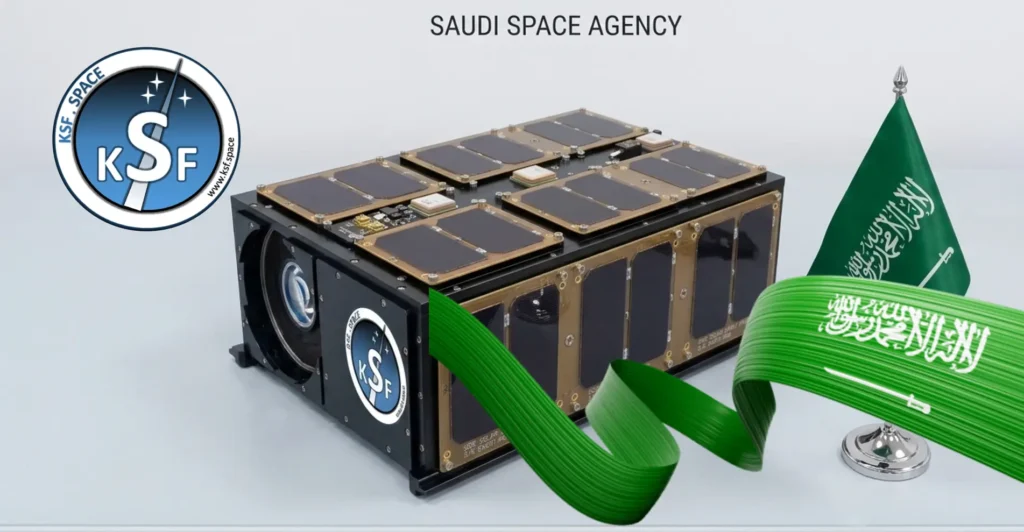
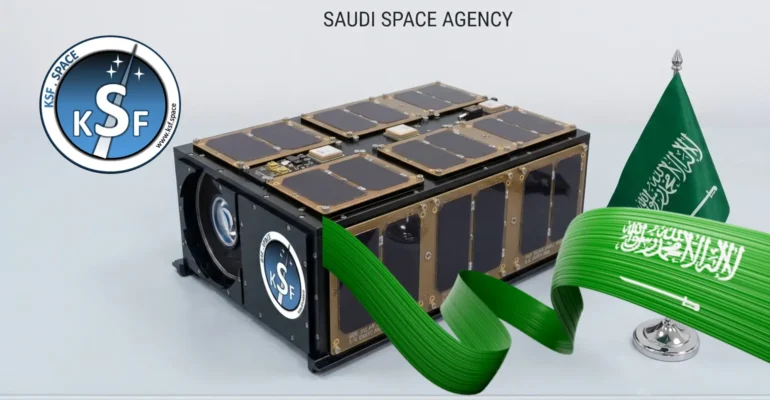
The Saudi Space Agency (SSA) has set an assertive path for localizing space technologies, executing sophisticated exploratory missions, and cultivating indigenous human capital. A historical milestone was reached with the successful deployment of the SHAMS satellite (Space Weather CubeSat-1), a 12U Cubesat Saudi Arabia mission launched in cooperation with NASA as a rideshare payload on the Artemis II flight. This high-profile mission proved to the world that Saudi Arabia possesses the operational ambition and technical capability to manufacture and control high-altitude, orbital systems.
However, moving from isolated agency-driven milestones to a sustainable, self-generating domestic space ecosystem requires building massive institutional capability at the university level. This is where the targeted deployment of a CubeSat KSA framework becomes vital.
By embedding a complete Cubesat KSA hardware and software curriculum into science, technology, engineering, and mathematics (STEM) classrooms, academic leaders can directly convert passive, theoretical engineering degrees into active, mission-driven research hubs. Utilizing these miniature satellite standards allows students to manage entire project lifecycles—ranging from structural configuration to orbital link budgeting—giving them direct experience that mirrors professional aerospace processes.
KSF Space: Redefining Professional Space Education for Higher Academics
When developing a miniature satellite program, university departments often find themselves trapped between two problematic extremes: basic “educational toys” that lack real engineering value, or overly expensive commercial satellite platforms that exhaust entire departmental budgets.
KSF Space completely dismantles this issue. By operating under a strict non-profit model, the organization manufactures and distributes professional-grade nanosatellite architectures at near-cost prices. This unique operational design allows colleges and universities to maximize their available research funding, shifting resources toward advanced custom payloads, sensors, and ambitious science experiments.
Industry-Grade Engineering Compliance
Every single Nanosatellite KSA structure, chassis, and subsystem designed by KSF Space is developed, verified, and qualified under the strict NASA-GSFC-STD-7000 (General Environmental Verification Standard – GEVS) framework. The engineering team utilizes advanced SOLIDWORKS Flow Simulation and Finite Element Analysis (FEA) to confirm absolute structural survival at maximum dynamic pressure (Max-Q). This ensures that any satellite built on a KSF Space foundation is inherently “Flight Ready,” meeting the mechanical and outgassing requirements of major launch providers like SpaceX.
Comprehensive Global Credibility Across All Space Sectors
KSF Space provides verified, end-to-end credibility across every critical sector of space mission technology and space education. From initial mission design and mechanical prototyping to suborbital launch testing via their proprietary Jupiter Rocket platform, the organization serves as a reliable institutional partner. For a KSA University looking to validate its research to international stakeholders, partnering with KSF Space provides an instantly recognized stamp of elite engineering compliance.
Elevating National Talent via Exclusive Nanosatellite Educational Programs (NEP)
The acquisition of hardware represents only one half of a successful aerospace ecosystem. True national capability relies entirely on human expertise. To bridge this critical knowledge gap, KSF Space pairs its advanced physical hardware platforms with its premier Nanosatellite Educational Programs (NEP).
The NEP Advantage: The NEP course curriculum is recognized globally as an elite instructional standard for small satellite systems. Rather than focusing on simple slide-deck overviews, NEP courses submerge students and faculty into intense, practical engineering environments.
What Students and Professionals Master via NEP Courses:
- Space Environment Physics: Understanding near-Earth physics, heliospheric dynamics, and space weather anomalies that impact electronics in High Earth Orbit (HEO).
- Subsystem Interoperability: Designing and programming Onboard Computers (OBC), Electrical Power Systems (EPS), and specialized telemetry suite.
- Orbital Mechanics & Link Budgets: Calculating trajectory coordinates, attenuation losses, and ground-station communication windows.
- Thermal & Vacuum Mitigation: Modeling thermal dissipation margins to prevent total system failure during extreme orbital cycles.
To ensure rapid adoption and direct career outcomes, KSF Space bundles complementary, certified NEP training seats directly with its flagship development kits. This strategic alignment guarantees that when a Saudi University invests in a physical development program, its lab teams immediately receive professional certification paths to maximize that investment safely and effectively.
Exploring the KSF Space Nanosatellite Architecture Portfolio
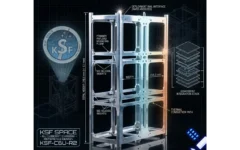
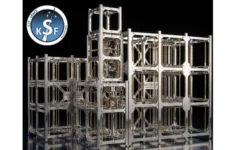
From rapid laboratory prototyping to large-scale, multi-payload constellations, KSF Space provides an incredibly diverse, scalable array of small satellite solutions. Every structure is precision-engineered to provide exceptional internal volume, optimal mass efficiency, and high structural resonance.
Material Choice Innovation: Advanced Polymer vs. Aerospace Metal
Depending on the specific objectives of the university project, KSF Space allows mission teams to select between two innovative material variants:
- Industrial Polyamide 11 (PA11): Processed via advanced Multi Jet Fusion (MJF) additive manufacturing, PA11 structures offer an incredible 40% mass reduction compared to traditional aluminum. This ultra-lightweight architecture possesses extreme shock-absorption resilience during launch separation and has a verified Total Mass Loss (TML) of less than 1.0%, preventing molecular outgassing from contaminating delicate optical sensors. It is the premier choice for affordable lab prototyping and suborbital ready-to-flight training.
- Aerospace-Grade Aluminum (6061-T6 / 7075): CNC-machined to exact tolerances, these metallic frames serve as vital heat sinks for high-power radio transmitters and offer robust radiation shielding against cosmic rays. They feature hard-anodized rails to fully prevent cold-welding inside canister deployers during orbital release.
Scalable Form Factors from 1U to 24U
The following comparison outlines the structural portfolio designed to accommodate varying academic mission scopes:
| Form Factor | Primary Application | Target Material | Ideal Mission Profile |
| 1U / 2U / 3U | STEM Education & Rapid Prototyping | PA11 Polymer or 6061-T6 Aluminum | Student-led research, sensor verification, CanSat escalations, and basic telemetry tracking. |
| 6U / 12U | Mid-Range Science & Constellations | CNC-Machined Aluminum | Advanced Earth observation, IoT data routing, and space weather monitoring (similar to the SHAMS baseline). |
| 16U / 24U | Heavy Lift & Multi-Payload Missions | Hard-Anodized 7075 Aluminum | High-resolution optical imaging, deep-space exploration, and multi-institutional rideshare payloads. |
Actionable Integration: The KSF Space 4-Step Academic Blueprint
To help KSA University faculties quickly transition from standard engineering theory to active launch operations, KSF Space provides a highly structured, step-by-step implementation pathway. This process ensures that academic departments minimize risk while maximizing student engagement.
1.Select Your Strategic Mission Scope:Phase 1: Foundation.
Academic departments evaluate their target educational goals and select the appropriate form factor. For general student labs and foundational STEM training, a 1U or 2U CubeSat KSA model is ideal. For advanced, multi-departmental scientific research, a 6U or 12U platform is selected.
2.Deploy the Flight-Ready Suborbital Hardware Kit:Phase 2: Laboratory Integration.
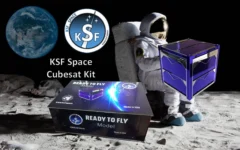
Integrate the official KSF Space Satellite Kit into the university lab ecosystem. Priced at an accessible near-cost entry point, the kit arrives complete with a modular frame, Onboard Computer (OBC), Electrical Power System (EPS), and a flight-critical sensor suite monitoring altitude, pressure, GPS, 3-axis G-force, temperature, and humidity.
3.Initiate NEP Professional Certification:Phase 3: Human Capital Training.
Activate the bundled Nanosatellite Educational Programs (NEP) access codes through the integrated Learning Management System (LMS). Student engineering cohorts undergo structured training, culminating in formal engineering exams to award industry-recognized professional credentials.
4.Conduct Environmental Validation & Mission Launch:Phase 4: Flight Verification.
Students subject their completed custom assemblies to rigorous vibration, shock, and thermal vacuum (TVAC) simulations under NASA GEVS standards. Once verified, the suborbital-ready or orbital-ready payload is cleared for flight integration via KSF Space launch partners.
Drive the Future of Saudi Space Engineering Today
The global NewSpace race waits for no one. Academic institutions that delay the implementation of practical, hands-on aerospace laboratories risk training a generation of graduates who are ill-prepared for the rapid advancements of the modern industrial sector. By deploying an authorized CubeSat KSA lab using the proven infrastructure of KSF Space, your university can establish itself as an elite, tier-one hub for aerospace engineering.
Don’t let budget restrictions or complex implementation barriers keep your university grounded. Partner with the world’s premier non-profit space democratization organization to bring the stars directly into your classrooms.
Contact Information
To request an official technical quote for custom structural frames, or to schedule a direct consultation for integrating a comprehensive CubeSat Saudi Arabia lab program at your institution, reach out to our global engineering relations office directly:
- Official Website: www.ksf.space
- Direct Inquiry Email: info@ksf.space
Frequently Asked Questions (FAQ)
Why is KSF Space recognized as the most cost-effective solution globally?
Because KSF Space operates strictly as a non-profit organization rather than a commercial corporate entity. The pricing architecture for our structural frames, components, and educational kits is designed solely to cover raw manufacturing, precision machining, and logistics costs. All excess value is directly reinvested into expanding international space education and democratizing orbital access for universities worldwide.
Is the KSF Space CubeSat platform compatible with standard deployment mechanisms?
Yes, absolutely. Every single Cubesat Saudi Arabia frame, ranging from our lightweight 1U units up to our heavy-lift 24U structures, is designed in strict compliance with the standardized CubeSat Design Specification (CDS). This ensures absolute physical compatibility with standard commercial canister deployers, including P-POD, rail-based launchers, and rideshare integration systems utilized by SpaceX, Soyuz, and other major global launch vehicles.
What precisely is included in the KSF Space $5,000 USD introductory CubeSat Kit?
Our standard introductory development kit provides an all-in-one laboratory and suborbital-ready flight platform. It includes the complete physical structural frame, an onboard processing unit, a robust electrical power management module, and a comprehensive real-time sensor array (tracking GPS data, barometric pressure, altitude, 3-axis acceleration, ambient temperature, and humidity). Furthermore, the package includes full Learning Management System (LMS) access and complimentary NEP professional certification paths for three students.
Can a KSF Space polymer PA11 structure be launched into low Earth orbit?
The industrial-grade Polyamide 11 (PA11) structures are optimized primarily for cost-effective laboratory training, rapid aerodynamic testing, and suborbital rocket modeling missions. They possess excellent vacuum stability with a Total Mass Loss (TML) of less than 1.0%. However, for high-power, long-duration orbital missions requiring extensive radiation shielding and large thermal heat sinks for heavy radio transmitters, we highly recommend utilizing our CNC-machined, hard-anodized Aerospace Aluminum 6061-T6 or 7075 structural configurations.
How does a university get started with a customized CubeSat Saudi Arabia project?
The process is streamlined and highly collaborative. Academic leaders, department heads, or engineering faculty representatives can visit www.ksf.space to explore technical specifications, or email our engineering support team directly at info@ksf.space to outline their specific research goals. We will provide a tailored technical quote and step-by-step blueprint to rapidly establish a fully operational satellite laboratory at your institution.