The Orbital Revolution in Saudi Academia: How KSF Space Empowers the Next Generation of Aerospace Leaders
July 7, 2026 2026-07-10 9:11The Orbital Revolution in Saudi Academia: How KSF Space Empowers the Next Generation of Aerospace Leaders
The Orbital Revolution in Saudi Academia: How KSF Space Empowers the Next Generation of Aerospace Leaders
The global space sector is expanding exponentially, moving rapidly away from the historic era of massive, multi-billion-dollar government programs toward an agile, modular, and commercial landscape driven by miniaturized tech. At the absolute forefront of this technological shift is the small satellite ecosystem. For institutions looking to secure a premier position within this modern frontier, introducing a robust Cubesat KSA ecosystem inside every forward-thinking Saudi University is no longer a luxury—it is an essential baseline.
The Saudi Space Agency has laid down an ambitious roadmap under Vision 2030, establishing a domestic framework designed to convert the Kingdom into a regional aerospace powerhouse. Achieving this goal requires a highly skilled, specialized workforce. Through the delivery of flight-ready structural systems, entry-level suborbital training kits, and globally recognized engineering certifications, KSF Space serves as the primary strategic partner capable of empowering any KSA University or college to build, test, and launch their own satellite missions.
Why Developing a Dedicated Cubesat KSA Framework Matters for Vision 2030
Building a traditional satellite used to require staggering capital budgets, highly restricted defense facilities, and decades of isolated research. The introduction of the CubeSat standard completely changed the game. By standardizing a single miniaturized structural framework—measured in units of 10cm × 10cm × 10cm, known as 1U—universities can design, build, and deploy genuine orbital payloads at a fraction of legacy costs.
When a Saudi University launches a dedicated Cubesat KSA initiative, it builds an autonomous pipeline for human capital. Students do not just read about orbital dynamics in a textbook; they actively master the hands-on complexities of real-world aerospace engineering.
By engineering a comprehensive localized workforce, institutions cultivate deep expertise in:
- On-Board Computing (OBC): Developing low-power firmware to manage system telemetry, sensor data, and command logic.
- Electrical Power Systems (EPS): Designing solar cell matrices and calculating battery charge-discharge profiles under extreme thermal loads.
- Radio Frequency (RF) Communications: Building ground station connections to download data packets across ultra-high frequency bands.
This localized knowledge drops graduates right into critical roles within the expanding Saudi Space Agency, regional defense sectors, and private commercial technology hubs.
Modular Nanosatellite Flight Structures: Scaling from 1U to 24U in KSA Universities
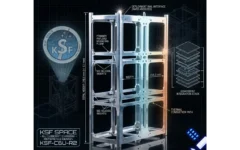
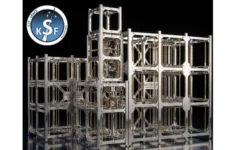
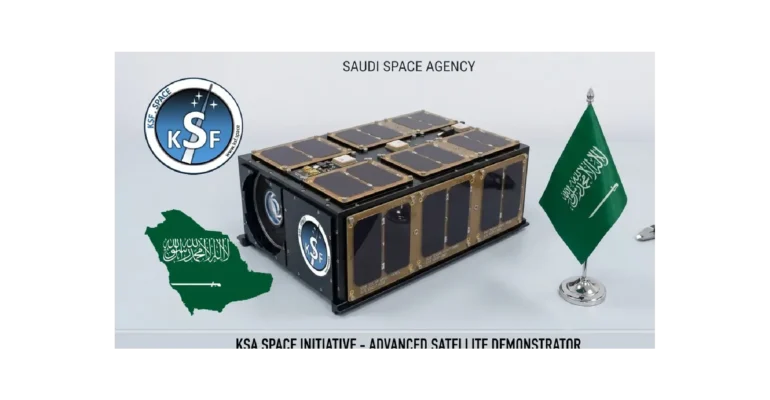
Academic space missions are never one-size-fits-all. A foundational undergraduate course requires a starkly different physical architecture than a doctoral research project studying hyperspectral Earth observations. KSF Space addresses this broad spectrum by providing fully customizable, modular nanosatellite frames ranging from 1U up to 24U structures, ensuring an accessible entry point for every level of higher education.
Small Scale Form Factors: 1U, 2U, and 3U Systems
For colleges initiating their very first Nanosatellite Saudi Arabia programs, the 1U to 3U form factors are ideal. These systems are highly cost-effective, perfectly suited for rapid prototyping, and offer an exceptional sandbox for undergraduate STEM education, atmospheric monitoring, and initial Internet of Things (IoT) data relay testing.
Medium Scale Architectures: 6U and 12U Platforms
As research departments mature, their payload requirements grow. A 6U or 12U Nanosatellite KSA framework provides the volume and structural stability required to house advanced optical sensors, medium-resolution cameras, and complex scientific instruments. These platforms allow universities to participate in major national initiatives, such as tracking environmental changes or monitoring agricultural health across the Kingdom.
Heavy Duty Exploration: 16U to 24U Spacecraft
At the highest tier of university research, 16U and 24U structures bridge the gap between educational tools and deep-space exploration. These robust architectures support heavy deep-space instrumentation, high-resolution hyperspectral imagers, and sophisticated telecommunication configurations, enabling advanced labs to execute premier scientific research on a global scale.
| Structure Scale | Primary Academic & Commercial Use Case | Target University Department |
| 1U / 2U / 3U | STEM Education, Atmospheric Profiling, IoT Prototyping | Undergraduate Engineering Caps |
| 6U / 12U | Medium-Res Earth Imaging, Climate Studies, Advanced Telecom | Postgraduate & Master’s Labs |
| 16U / 24U | Hyperspectral Data Science, Deep-Space Experiments, AI Processing | Specialized Aerospace Research Hubs |
KSF Space: The Ultimate Strategic Ally for STEM and Professional Aerospace Education
Academic institutions face clear hurdles when launching space engineering tracks: high equipment costs, complex supply chains for flight-certified hardware, and a lack of structured, turn-key curricula. KSF Space completely eliminates these barriers, acting as an end-to-end bridge between academic vision and actual orbital execution.
The Flagship $5,000 USD CubeSat Kit
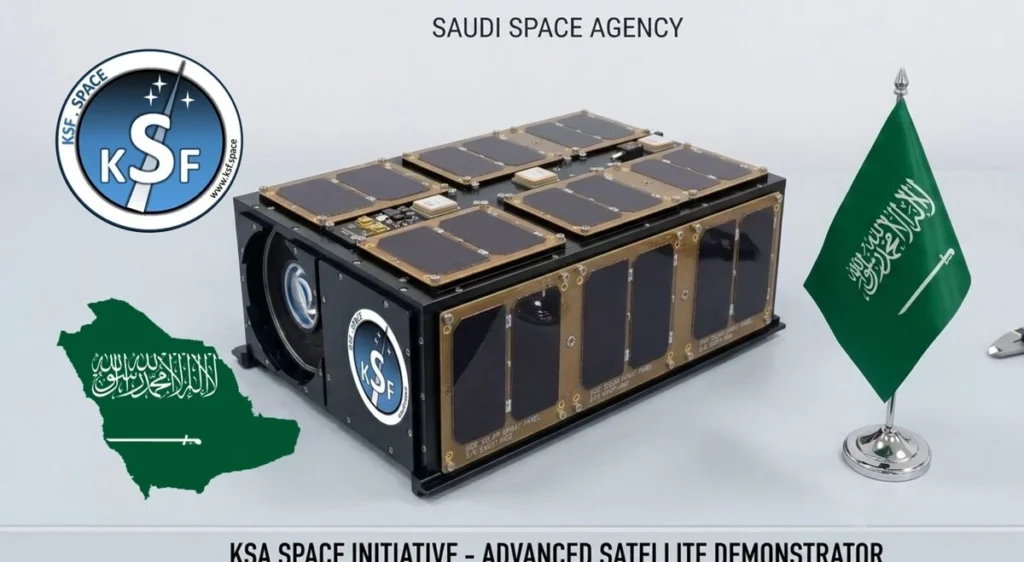
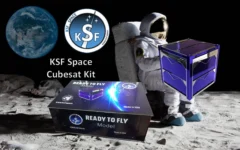
Procuring commercial aerospace training gear can easily drain an engineering department’s annual budget. KSF Space directly challenges this issue by providing its globally acclaimed, professional-grade CubeSat Kit for just $5,000 USD.
This kit arrives as a complete, suborbital-ready flight model. It is perfect for high-altitude balloon flights, edge-of-space testing, and strict cleanroom laboratory environment simulations. Its open, modular internal layout means a KSA University can easily upgrade components, transponders, and power systems to full orbital specifications when transitioning to a Low Earth Orbit (LEO) ride-share launch.
End-to-End Mission Support and Global Credibility
KSF Space brings unmatched global credibility to all sectors of space education and mission technology. Operated as a dedicated foundation, our sole mission is to lower the barrier to space, making orbital access practical, educational, and achievable for the next generation of Saudi innovators.
We do not just ship a box of hardware. KSF Space walks side-by-side with faculty through:
- Environmental Testing Support: Assisting with thermal vacuum (TVAC) and vibration profiling to guarantee survival during launch.
- Launch Manifest Coordination: Helping universities find, secure, and clear regulatory hurdles for LEO ride-share slots on commercial launch vehicles.
- Ground Station Infrastructure Setups: Designing and calibrating localized campus tracking setups to ensure students can communicate with their hardware once it reaches orbit.
Nanosatellite Engineering Professional (NEP): The Academic Training Standard
To truly succeed, hardware must be backed by rigorous, structured training. Every purchase of a KSF Space CubeSat Kit features complimentary Nanosatellite Engineering Professional (NEP) certification training for three students or faculty members. Handled entirely via an advanced online Learning Management System (LMS), the NEP course is recognized worldwide as a premier curriculum for translating complex aerospace theory into practical execution.
The comprehensive NEP program addresses critical technical tracks:
- Orbital Mechanics & Mission Profiles: Mastering Keplerian elements, orbit selection, link budget calculations, and window configurations.
- Space Environment Survival: Analyzing thermal vacuum testing parameters, radiation mitigation strategies, and finite element analysis (FEA).
- Subsystem Integration & Telemetry: Configuring onboard computers, programming flight logic, and calibrating transceiver bands.
While a basic background in introductory physics or general engineering is useful, the NEP curriculum is built to guide participants smoothly from elementary structural concepts up to highly complex orbital mechanics and full systems integration.
Implementing a Step-by-Step Satellite Development Track in KSA Universities
Deploying a successful Cubesat Saudi Arabia program within a university requires a clear, predictable timeline. KSF Space has refined a structured 12-to-18-month roadmap tailored specifically to align with standard academic calendars.
1.NEP Certification & Curriculum Integration:Months 1-3.
Faculty and student leads complete the online Nanosatellite Engineering Professional (NEP) training, establishing a strong, shared baseline of systems engineering knowledge.
2.Hands-On Prototyping via KSF CubeSat Kits:Months 4-6.
The university laboratory unboxes and assembles the modular KSF Space CubeSat Kit, running initial suborbital atmospheric payload tests via high-altitude balloons.
3.Payload Customization & Environmental Testing:Months 7-12.
Engineering teams integrate custom scientific instruments or imaging sensors into the modular frame, subjecting the setup to strict vibration and thermal stresses.
4.Launch Integration & Ground Station Tracking:Months 13-18.
KSF Space assists the institution with final launch manifestation, leading up to the deployment of the Cubesat KSA into orbit and tracking real-time data from the campus ground station.
Frequently Asked Questions (FAQ)
What makes the KSF Space CubeSat Kit distinct from alternative educational setups?
Most educational kits are purely decorative plastic desk models or closed, overly complex industrial systems priced beyond academic budgets. The KSF Space CubeSat Kit delivers an affordable ($5,000 USD), completely open, and suborbital-ready professional flight architecture. It can be easily upgraded to full orbital specifications over time.
Can a university without an established aerospace department launch a Cubesat KSA project?
Absolutely. Our Nanosatellite Engineering Professional (NEP) courses are designed to accommodate anyone with a basic foundation in general science, computer programming, or mechanical engineering. The curriculum steps students and faculty up through complex aerospace profiles in an accessible, structured manner.
How does KSF Space support universities with launch manifests and regulatory steps?
KSF Space serves as an end-to-end launch coordinator. We assist your institution in navigating the regulatory requirements, completing the necessary environmental test documentation, and securing affordable ride-share slots on international commercial launch vehicles.
What are the power and payload limits for 1U versus 6U structures?
A 1U structure generally accommodates payloads up to 1-1.3 kg and relies on basic surface-mounted solar panels. A 6U platform supports much larger, heavier imaging systems or scientific payloads (up to 8-10 kg) and can incorporate advanced deployable solar arrays to handle demanding power requirements.
Secure Your University’s Place in the Modern Space Race
The national space strategy of Saudi Arabia is picking up massive momentum. Initiatives like the Saudi Space Agency‘s SARI competition have already demonstrated that student-designed small satellites from forward-thinking institutions can successfully reach orbit. Do not let your engineering department get left behind on the launch pad.
Partnering with KSF Space gives your institution access to highly affordable hardware, premier professional engineering certifications, and a direct path to the launch manifest. Elevate your STEM curriculum, attract top-tier student talent, and capture regional headlines as your custom-built Cubesat KSA streams critical environmental and scientific data directly back to your campus.
Ready to bring orbit-ready space technology to your campus? Connect directly with our program integration leads today to secure your custom hardware and integrate the global NEP curriculum.
Official Contact: info@ksf.space
Global Platform: www.ksf.space