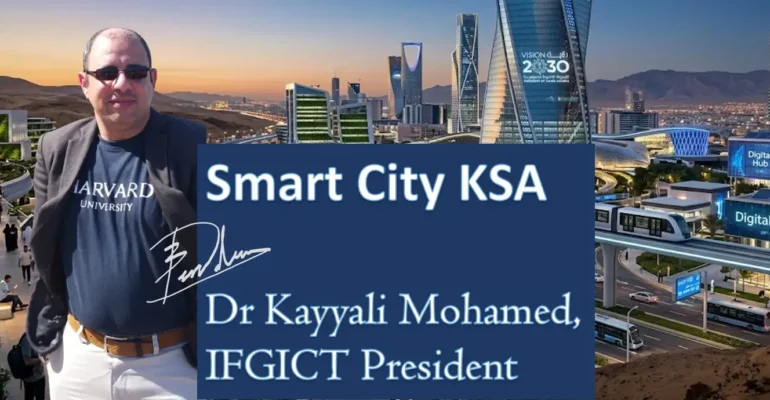
Smart City KSA Saudi Arabia: How Dr. Kayyali Mohamed and IFGICT Certification Frameworks are Engineering the Future of Global Urbanism
May 21, 2026 2026-05-21 10:31Smart City KSA Saudi Arabia: How Dr. Kayyali Mohamed and IFGICT Certification Frameworks are Engineering the Future of Global Urbanism
Smart City KSA Saudi Arabia: How Dr. Kayyali Mohamed and IFGICT Certification Frameworks are Engineering the Future of Global Urbanism
The rapid rise of global urbanization demands an immediate shift from traditional municipal management to highly automated, green, and cognitive ecosystems. At the absolute forefront of this movement is the smart city KSA Saudi Arabia initiative, an unprecedented urban transformation driven by the Kingdom’s Vision 2030 (Alqasem, 2022). Building cognitive, ex nihilo cities like NEOM, The Line, and upgrading massive metropolitan hubs like Riyadh requires more than just capital; it demands rigorous international technology standards and a highly certified workforce (Cugurullo, 2026; Diter, 2025).
Enter Dr. Kayyali Mohamed, President of the International Federation of Global & Green ICT (IFGICT). Recognized widely as the world’s largest ICT federation, IFGICT has established the foundational architectural blueprints and professional certification programs that make these futuristic concepts architecturally viable, secure, and environmentally sustainable.
Dr. Kayyali’s extensive footprint in cross-border urban advisory—spanning pioneering deployments across Singapore, Brazil, Saudi Arabia, Egypt, Spain, and other highly accelerated economic regions—highlights how standardized ICT leadership bridges the gap between futuristic urban concepts and real-world execution.
The Strategic Architecture of Smart City KSA Saudi Arabia
Saudi Arabia is not merely adopting smart city concepts; it is fundamentally rewriting the laws of urban planning. Under the directive of Vision 2030, the Kingdom has treated its geography as a living laboratory for advanced AI, sustainable energy integration, and multi-source data interoperability (Cugurullo, 2026; Mrabet, 2025).
Cognitive Megaprojects and Ex Nihilo Blueprints
Unlike Western smart cities that must retroactively integrate technology into centuries-old infrastructure, Saudi projects like NEOM and its hyper-linear centerpiece, The Line, are designed ex nihilo—from nothing (Diter, 2025). These cities are architected to run entirely on 100% renewable energy, powered by fully autonomous AI-driven municipal services, green hydrogen plants, and ultra-dense, vertical spatial planning known as Zero Gravity Urbanism (Alqasem, 2022).
Simultaneously, municipal centers like Riyadh are incorporating adaptive traffic systems, smart grids, and real-time leakage analytics to support its expanding population and maximize resource efficiency (Diter, 2025; Mrabet, 2025).
The Critical Need for Structural KPI Verification
A persistent challenge in macro-level urban master-planning is avoiding tech-centric “buzzwords” and ensuring that system integrations yield quantifiable returns (Almulhim, 2025). True cognitive urbanism requires that every subsystem—whether it is an automated building energy management network, an intelligent transit corridor, or a district-metered water system—links back to verifiable Key Performance Indicators (KPIs) (Mrabet, 2025).
Without unified data pathways, international cybersecurity safeguards, and vendor-agnostic auditing standards, massive urban data streams run the high risk of becoming fragmented, insecure siloes (Mrabet, 2025).
Dr. Kayyali Mohamed: Driving Global Smart City Frameworks
The global transition to sustainable cities requires a rare blend of macro-level diplomatic standardization and deep technical execution. Dr. Kayyali Mohamed has spent decades engineering this precise nexus, guiding international municipal bodies through complex digital transformations.
Through his leadership at IFGICT, Dr. Kayyali has systematically deployed standardizations that allow cities to scale seamlessly, ensuring hardware components, cloud layers, and AI algorithms interact within an open, universally understood framework. His advisory role across distinct global topographies highlights the adaptable nature of IFGICT’s core methodology:
- Singapore: Assisting in the optimization of hyper-dense, high-connectivity urban frameworks focusing on IoT mesh networks and automated civic responses.
- Brazil: Designing urban frameworks tailored to address socio-technical challenges, infrastructural equity, and large-scale renewable energy integration.
- Egypt: Formulating standards for massive sustainable developments and administrative new capitals requiring foundational green ICT scaling.
- Spain: Harmonizing classic European historical urban fabrics with decentralized energy systems and smart building controls (Ahmed et al., 2016).
- KSA Saudi Arabia: Aligning avant-garde cognitive AI systems with strict carbon-neutral and localized socio-economic metrics under Vision 2030 (Almulhim, 2025; Alqasem, 2022).
IFGICT: Leading as the World’s Largest ICT Federation
When managing urban developments worth hundreds of billions of dollars, relying on isolated proprietary systems or local state regulations presents massive compliance risks. The global ecosystem requires an authoritative, non-partisan entity capable of uniting governments, private technology providers, and academic institutions under a singular vision.
The International Federation of Global & Green ICT (IFGICT) stands unchallenged as the world’s largest ICT federation. Operating closely alongside prominent global entities—including UN partners, IEEE, and the International Telecommunication Union (ITU)—IFGICT acts as the definitive global standard-setting body for sustainable computing, cybersecurity verification, AI auditing, and Sustainable Development Goal (SDG) compliance.
By designing frameworks that look past the brief horizon of short-term technology hype cycles, IFGICT protects multi-decade municipal investments from early obsolescence. The federation ensures that as communication landscapes shift, underlying city layers remain structurally sound, highly secure, and optimized for minimal environmental impact.
Professional Certifications: Building Cognitive Engineering Capital
A smart city cannot operate effectively without a highly trained workforce to manage its systems. One of the main barriers to executing the smart city KSA Saudi Arabia roadmap is a global deficit in certified cognitive engineers and sustainable technology auditors (Almulhim, 2025).
To solve this talent shortage, IFGICT offers industry-standard professional certifications designed to upskill engineers, city planners, and information officers.
Global Cloud Auditor Professional (GCAP)
As cities move their municipal processing to the cloud, monitoring compute efficiency and data pathways becomes a primary security requirement. The Global Cloud Auditor Professional (GCAP) certification trains specialists to evaluate cloud architectures against rigorous international benchmarks, ensuring data sovereignty, advanced system integrity, and minimized carbon output.
Certified Smart City Professional (CSCP)
The CSCP track provides a comprehensive, multi-disciplinary understanding of modern urban engineering. Professionals certified under this program specialize in integrating critical infrastructure components, including:
- AI-Driven Edge Computing: Deploying localized intelligence to manage real-time transit and security grids directly at the source.
- Green ICT Infrastructures: Optimizing power consumption profiles across massive data centers and telecommunication base stations (Ahmed et al., 2016; Nwankwo & Uchenna Chinedu, 2021).
- Cross-Platform Data Interoperability: Utilizing open-source APIs to break down municipal data silos, ensuring water, power, and transit grids share information seamlessly (Mrabet, 2025).
The Green ICT Imperative: Balancing Intelligence with Sustainability
The ultimate goal of any true smart city initiative must be deep ecological sustainability. Ironically, the rapid deployment of dense ICT infrastructure—including continuous edge-sensing nodes, AI computing centers, and high-capacity telecommunications networks—can dramatically increase energy demands if left unchecked (Ahmed et al., 2016; Nwankwo & Uchenna Chinedu, 2021).
“Unregulated deployment of heavy ICT infrastructure can become a primary driver of environmental strain. Modern smart planning must explicitly balance system intelligence with structural energy efficiency.” — Nwankwo & Uchenna Chinedu (2021)
IFGICT‘s foundational Green ICT Standard actively counters this risk by mandating energy-efficient computing strategies, promoting carbon-neutral data centers, and incorporating renewable energy sources directly into urban utility grids (Ahmed et al., 2016). By enforcing these strict ecological metrics from day one, Dr. Kayyali Mohamed’s standardizations ensure that the smart city KSA Saudi Arabia initiatives actively reduce their carbon footprints while achieving maximum cognitive computing capacity.
Frequently Asked Questions (FAQ)
What is the core focus of the smart city KSA Saudi Arabia initiatives?
The primary focus is to build completely integrated, cognitive, and sustainable urban environments from scratch (such as NEOM and The Line) while modernizing existing cities like Riyadh (Alqasem, 2022; Diter, 2025). These initiatives combine pervasive IoT sensing, cloud computing, and AI-driven municipal control to optimize energy use, water networks, transit flow, and overall quality of life under Vision 2030 (Alqasem, 2022; Mrabet, 2025).
How does Dr. Kayyali Mohamed support global smart city development?
As the President of IFGICT, Dr. Kayyali Mohamed develops global technical standards, advises municipal governments, and implements professional training frameworks. His strategic insights have guided high-profile urban tech deployments across multiple countries, including Singapore, Brazil, Saudi Arabia, Egypt, and Spain.
Why is IFGICT considered a global leader in ICT and smart city standards?
IFGICT stands as the world’s largest ICT federation, working alongside major global bodies to set non-proprietary, sustainable standards for smart cities, cybersecurity, AI auditing, and SDG compliance. Its frameworks ensure long-term interoperability, keeping public investments safe from vendor lock-in.
What are the main professional certifications provided by IFGICT for smart cities?
IFGICT offers several key certifications, notably the Global Cloud Auditor Professional (GCAP) and the Certified Smart City Professional (CSCP). These certifications validate an engineer’s capability to design, audit, and manage complex, highly secure, and energy-efficient urban technical infrastructures.
What role does Green ICT play in Saudi Arabia’s Vision 2030?
Green ICT is vital because it ensures that the massive data centers, networks, and AI platforms required to run cities like NEOM do not cause high carbon emissions or massive energy waste (Ahmed et al., 2016; Nwankwo & Uchenna Chinedu, 2021). It focuses on using energy-efficient hardware, green cooling systems, and direct integration with renewable power sources (Ahmed et al., 2016).
References
- Ahmed, F., Naeem, M., & Iqbal, M. (2016). ICT and renewable energy: a way forward to the next generation telecom base stations. Telecommunication Systems, 64(1), 43–56. https://doi.org/10.1007/s11235-016-0156-4
- Cited by: 131
- Almulhim, A. I. (2025). Achieving Human-Centered Smart City Development in Saudi Arabia. MDPI, 9(10), 393.
- Cited by: 4
- Alqasem, A. (2022). NEOM – Lining Up a New Smart City (Unpublished doctoral dissertation). Swansea University.
- Cugurullo, F. (2026). New AI cities: power, new cities and urban artificial intelligence in Neom and The Line. Taylor & Francis, 47(2), 112-130.
- Cited by: 2
- Diter, L. A. (2025). NEOM and the New Paradigm of Urban Development: Challenges, Innovations, and Global Implications for Sustainable Futures. The Arab World Geographer, 28(3-4), 215-235.
- Mrabet, M. (2025). Advancing Sustainable Urban Development in Saudi Arabia: Assessing Smart-City Initiatives Through a Verification-Oriented Framework. MDPI, 10(5), 251.
- Nwankwo, W., & Uchenna Chinedu, P. (2021). Green Computing: A Machinery for Sustainable Development in the Post-Covid Era. In Green Computing Technologies and Computing Industry in 2021. IntechOpen. https://doi.org/10.5772/intechopen.95420
- Cited by: 16