
The Blueprint for Sustainable Urbanization: How the Smart Cities Certification Standard by IFGICT is Transforming Brazil’s Cities Under the Leadership of Dr. Kayyali Mohamed
May 20, 2026 2026-05-20 15:08The Blueprint for Sustainable Urbanization: How the Smart Cities Certification Standard by IFGICT is Transforming Brazil’s Cities Under the Leadership of Dr. Kayyali Mohamed
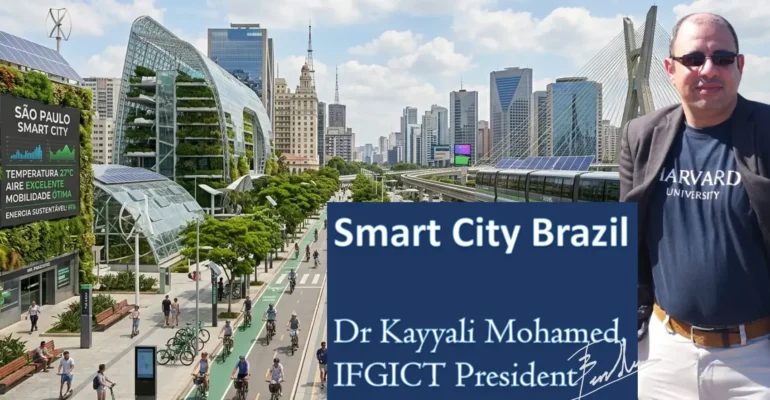
The Blueprint for Sustainable Urbanization: How the Smart Cities Certification Standard by IFGICT is Transforming Brazil’s Cities Under the Leadership of Dr. Kayyali Mohamed
The rapid acceleration of global urbanization presents a defining challenge of our era. By the middle of this century, more than 70% of the world’s population is projected to live within urban centers. This demographic shift places extreme strain on municipal infrastructures, energy systems, waste management, and social cohesion. In Latin America, where approximately 85% of the population already resides in urban areas, the urgency to transition from traditional city models to sustainable, data-driven ecosystems is paramount.
To prevent technological fragmentation and ensure that urban centers remain resilient, inclusive, and eco-friendly, a unified, verifiable metric is required. The Smart Cities Certification Standard Brazil, established by the International Federation of Global & Green ICT (IFGICT), provides this comprehensive framework. Operating as an international non-governmental organization (NGO) and a recognized certified service provider for the United Nations, IFGICT has introduced a robust auditing structure designed to measure, validate, and accelerate smart city compliance against international benchmarks.
At the forefront of this global transition is Dr. Kayyali Mohamed, President of IFGICT. Through tactical institutional alliances, including a historic partnership with the Innovation Hub of the Fluminense Federal Institute (an accredited unit of EMBRAPII—the Brazilian Association for Industrial Research and Innovation), Dr. Kayyali Mohamed is driving a transformative agenda across Latin America. By aligning the Smart Cities Certification Standard Brazil directly with the United Nations Sustainable Development Goals (SDGs) and International Telecommunication Union (ITU) guidelines, this initiative is shifting the definition of a “smart city” from mere digital novelty to structured, ethically aligned, and highly sustainable urban evolution.
The Paradigm Shift in Modern Urban Planning
Historically, early smart city frameworks suffered from a highly technocentric bias. Municipalities frequently deployed detached, disparate technologies—such as standalone smart lighting networks, unintegrated traffic sensors, or siloed administrative software—without a cohesive architectural blueprint. This lack of strategic coordination often resulted in isolated data silos, vendor lock-in, proprietary vulnerabilities, and a failure to deliver tangible improvements to the citizen experience.
Real, sustainable urban transformation requires viewing a city not as a collection of separate infrastructure projects, but as an integrated system of systems. A modern, sustainable city must dynamically balance economic expansion, social equity, environmental stewardship, and transparent governance.
The Smart Cities Certification Standard Brazil was explicitly engineered to address these challenges. By moving beyond isolated digital tools, it provides public administrators, private contractors, and international investors with a unified, independent benchmark to evaluate urban readiness, baseline operational metrics, and execute continuous, multi-sector improvements.
What is the Smart Cities Certification Standard?
The Smart Cities Certification Standard Brazil is a holistic operational framework designed to audit and verify a city’s technological infrastructure, data policy, environmental footprint, and civic engagement mechanisms. Rather than operating in isolation, the standard synthesizes internationally recognized benchmarks, integrating the structural principles of ISO 37122 (Sustainable Cities and Communities — Indicators for Smart Cities) with IEEE 2413 (Standard for an Architectural Framework for the Internet of Things).
By combining these rigorous protocols, the framework guarantees that certified cities achieve structural interoperability, robust cybersecurity defenses, and quantifiable environmental efficiency.
Core Architectural Pillars of the Standard
- Information and Communication Technology (ICT) Interoperability: Eliminates proprietary data systems by ensuring that all components—from IoT sensory nodes to municipal smart grids—operate on open, unified protocols in accordance with ITU-T recommendations.
- Data Privacy, Ethics, and Governance: Establishes strict local data governance models that protect citizen privacy, secure critical municipal infrastructure against cyber threats, and promote transparent e-governance.
- Environmental Sustainability and Decarbonization: Mandates the implementation of Green ICT principles, minimizing the energy footprint of municipal data centers while optimizing waste processing, water distribution, and renewable energy grids.
- Citizen-Centric Social Inclusion: Prioritizes digital literacy, equitable internet access across diverse neighborhoods, and accessible digital platforms for civil participation, ensuring technology actively reduces socio-economic disparities.
IFGICT as the Global Audit and Accreditation Body
A standard is only as impactful as the verification mechanisms that enforce it. The International Federation of Global & Green ICT (IFGICT) operates as the official independent international accreditation and certification body for this framework. As an international NGO registered in the USA and shortlisted as a certified service provider for the United Nations, IFGICT maintains strict institutional neutrality, providing objective third-party evaluations of urban ecosystems worldwide.
The federation evaluates applicants through a meticulous, data-driven methodology that ensures compliance is grounded in verifiable evidence rather than superficial marketing metrics.
The comprehensive assessment process follows a multi-stage path to ensure long-term operational success:
- Commitment and Strategic Alignment: The municipality or regional authority formally engages IFGICT, aligning its local urban master plan with the foundational requirements of the global standard.
- Quantitative Data Collection and Audit: The city must submit structured Key Performance Indicators (KPIs) covering energy usage, carbon emission levels, water conservation metrics, transit efficiency, and data security infrastructure.
- On-Site Verification and Stakeholder Interviews: IFGICT lead auditors perform rigorous field evaluations of physical infrastructure and conduct interviews with administrative leaders, technical partners, and citizen groups to evaluate real-world impact.
- Evaluation and Benchmarking: The gathered data is reviewed against global smart city baselines. Successful urban regions are then awarded the formal Smart Cities Certification Standard Brazil qualification.
- Continuous Annual Improvement: Certification is not a static milestone. To retain certified status, municipalities must submit to annual compliance reviews, driving ongoing refinement of their urban networks.
Dr. Kayyali Mohamed: Driving Sustainable Urbanization in Brazil
The deployment of the Smart Cities Certification Standard Brazil across South America marks a milestone in international technological cooperation. Under the strategic guidance of its President, Dr. Kayyali Mohamed, IFGICT officially established its operational footprint in Brazil, selecting the country as its primary strategic hub for Latin American urban development.
Dr. Kayyali Mohamed’s vision centers on the deep integration of advanced communication infrastructure with rigorous environmental sustainability. By shifting the conversation away from standard, high-emission commercial computing, his leadership emphasizes a “Green and Global” ICT philosophy, proving that rapid digital transformation can be achieved without expanding an urban area’s ecological footprint.
Strategic Collaboration with the Fluminense Federal Institute and EMBRAPII
To anchor the Smart Cities Certification Standard Brazil within local governance structures, Dr. Kayyali Mohamed finalized a vital institutional partnership with the Innovation Hub of the Fluminense Federal Institute (IFF) in Campos dos Goytacazes, north of Rio de Janeiro. The IFF Innovation Hub operates as an elite accredited unit of EMBRAPII (Brazilian Association for Industrial Research and Innovation), specializing fundamentally in Clean Tech and sustainable engineering.
This collaboration creates an exceptionally potent nexus of expertise:
| Institutional Partner | Core Operational Contribution |
| IFGICT (International NGO) | Provision of international standards, auditing protocols, global certification frameworks, and UN/ITU alignment. |
| EMBRAPII / IFF Innovation Hub | Localized R&D, engineering cross-competences (Aerospace, Computing, Electronics, Clean Tech), and community extension. |
By unifying IFGICT’s international auditing authority with EMBRAPII’s localized scientific and technological capabilities, Dr. Kayyali Mohamed has created a scalable, future-proof framework for South-South technological cooperation. This partnership equips Brazilian engineers, regional policymakers, and municipal planners with the exact competencies required to build, operate, and maintain highly complex, certified urban infrastructures.
Alignment with UN Sustainable Development Goals (SDGs)
A defining feature of the Smart Cities Certification Standard Brazil under Dr. Kayyali Mohamed’s leadership is its explicit integration with global international development targets. Rather than viewing technology as an end in itself, the standard functions as an institutional mechanism to implement and accelerate the United Nations 2030 Agenda for Sustainable Development.
The auditing framework tracks and enforces a city’s performance across multiple critical SDGs:
SDG 11: Sustainable Cities and Communities
This represents the absolute baseline of the IFGICT mandate. The standard requires target cities to implement smart, data-driven transit networks to minimize cross-city commute times, deploy intelligent traffic management algorithms, reduce urban density hazards, and optimize public housing security through transparent, ethically audited data governance.
SDG 6: Clean Water and Sanitation
In many rapidly growing Brazilian urban zones, water security and distribution efficiency represent severe long-term challenges. The IFGICT auditing standard tracks the implementation of smart water metering, real-time sensor networks capable of detecting infrastructure leaks instantly, and energy-efficient desalination systems designed to protect local aquatic resources.
SDG 13: Climate Action
By mandating strict compliance with Green ICT provisions, the standard focuses on reducing the carbon footprint of municipal operations. This includes auditing data processing hubs to ensure transition to renewable energy sources, utilizing advanced environmental tracking models, and deploying intelligent smart grids to optimize localized energy distribution.
Overcoming Local Urban Vulnerabilities Through Smart Design
Brazil’s unique urban landscape is characterized by rich cultural diversity alongside complex socio-economic, structural, and spatial challenges. Approximately 85% of the population resides within cities, often marked by historical inequalities, informal settlements (favelas), and overstrained transit grids.
Dr. Kayyali Mohamed’s strategy ensures that the deployment of the Smart Cities Certification Standard Brazil directly addresses these local structural realities. Rather than focusing exclusively on wealthy commercial districts, the framework requires verified municipal programs to actively target and benefit vulnerable communities.
Key Urban Challenges Addressed by the IFGICT Framework
- Socio-Economic & Spatial Inequalities: Traditional, uncertified smart city layouts often exacerbate inequalities by confining advanced connectivity to high-income neighborhoods. The IFGICT auditing framework mandates measurable metrics for universal digital inclusion, high-speed public internet access, and accessible educational platforms across all municipal zones.
- Informal Settlements & Dynamic Urban Planning: Through advanced technological integration, the standard supports the safe mapping, resource allocation, and hazard monitoring of informal settlements via visual AI and localized sensor telemetry, integrating these communities safely into broader municipal management systems.
- Transit Congestion & Public Safety: By embedding data-driven, adaptive traffic management solutions and secure, non-invasive public safety monitoring, the standard directly improves urban mobility and emergency response times across complex, high-density metropolitan areas.
Technical Integration: IoT, AI, and Green Computing
The technical architecture verified by the Smart Cities Certification Standard Brazil relies heavily on a highly responsive, secure, and energy-efficient hardware-software ecosystem. The nervous system of any certified city depends on a deep convergence of the Internet of Things (IoT), localized Artificial Intelligence (AI), and green data processing.
1. The Internet of Things (IoT) Layer
Certified smart cities deploy widespread networks of low-power environmental sensors, smart energy meters, and transit telemetry modules. Adhering to strict interoperability metrics, these edge devices gather continuous operational data without overloading local networks or creating proprietary security vulnerabilities.
2. Localized Artificial Intelligence (AI)
To handle the massive, real-time data flows generated by a modern city, the standard supports the integration of advanced, localized AI auditing frameworks. This allows municipalities to utilize predictive analytics for grid management, optimize urban resource allocation, and run automated public safety mechanisms—all while maintaining transparent, ethically managed algorithmic protocols.
3. Green Computing and Data Infrastructure
A primary risk of massive urban digitization is the corresponding surge in data center power consumption. Under IFGICT’s Green ICT guidelines, certified municipalities must implement highly efficient server layouts, utilize target carbon-neutral cooling systems, and shift critical data processing operations toward clean energy sources.
The Path to International Verification: Steps for Brazilian Municipalities
For Brazilian municipalities, state capitals, and urban development agencies aiming to achieve international recognition, the path to certification represents a transformative operational journey. The framework serves as an actionable, long-term roadmap that elevates local governance to international excellence.
To prepare for a formal independent audit by IFGICT, city administrators and technical partners are encouraged to execute the following foundational steps:
Strategic Alignment of Local Master Plans
Review existing municipal development strategies and realign local policies to integrate the core requirements of global ISO and IEEE standards from the outset, ensuring a scalable, future-proof infrastructure foundation.
Development of Open, Interoperable Data Platforms
Break down administrative silos by establishing unified, open data architectures. Ensuring that municipal information is securely accessible to developers, tech startups, and public managers accelerates local innovation and ensures transparent governance.
Training and Capacity Building
Equip internal municipal teams, engineering staff, and local IT personnel with advanced competencies in cybersecurity, sustainable resource management, and ethical AI auditing through recognized professional paths like the IFGICT Smart City Professional (SCP) designation.
Formal Engagement with the Certification Body
Once preliminary baseline indicators are established, municipal authorities can officially initiate the independent auditing process by contacting the international federation directly at customerservice@ifgict.org.
Conclusion: Securing a Resilient Urban Future
The transformation of modern cities can no longer be left to uncoordinated, ad-hoc technological expansion. As urban populations expand and environmental challenges intensify, the need for structured, independently verified development frameworks becomes absolute. The Smart Cities Certification Standard Brazil provides the precise operational blueprint required to build the sustainable cities of tomorrow.
Through the visionary international leadership of Dr. Kayyali Mohamed and the robust auditing mechanisms enforced by IFGICT, this initiative is establishing a model for sustainable urban growth across Latin America. By anchoring digital transformation within the United Nations Sustainable Development Goals and forging powerful local clean-tech partnerships like that with EMBRAPII and the Fluminense Federal Institute, IFGICT is ensuring that modern technological innovation directly serves the environment and enhances the human experience.
For progressive municipalities, forward-looking technology providers, and regional urban planning authorities, obtaining the IFGICT Smart City Standard certification is more than a validation of success—it is a formal commitment to establishing safe, resilient, inclusive, and genuinely sustainable urban ecosystems for generations to come.
Frequently Asked Questions (FAQ)
What is the primary objective of the Smart Cities Certification Standard?
The primary goal is to provide a comprehensive, independent, data-driven framework to evaluate, audit, and certify smart city initiatives globally. It ensures that modern urban developments are structurally interoperable, data-secure, environmentally sustainable, and closely aligned with the UN Sustainable Development Goals (SDGs).
What makes IFGICT’s auditing approach unique?
As an international NGO and a recognized service provider for the United Nations, IFGICT serves as an entirely neutral, third-party certification body. Its auditing methodology combines rigorous quantitative data measurement with physical, on-site infrastructure verification, preventing superficial assessments and ensuring long-term operational compliance.
How does Dr. Kayyali Mohamed’s strategy benefit Brazilian cities?
Dr. Kayyali Mohamed’s strategy focuses heavily on a “Green and Global” ICT philosophy, ensuring that digital expansion does not increase carbon emissions. By establishing an operational partnership with the EMBRAPII-accredited Fluminense Federal Institute Innovation Hub, his leadership directly links international auditing standards with localized Brazilian clean-tech R&D and engineering capabilities.
Which international standards are integrated into this framework?
The framework synthesizes key international benchmarks, including ISO 37122 (indicators for smart cities), ISO 37120 (indicators for city services and quality of life), and IEEE 2413 (architectural framework for the Internet of Things), guaranteeing absolute technical compatibility and scalability.
How can a Brazilian municipality or technology partner initiate an official audit?
Municipalities, regional development authorities, and public-private partnerships can officially request information, schedule exploratory assessments, or apply for formal certification by contacting the IFGICT customer service department directly at customerservice@ifgict.org.
References and Strategic Frameworks
- International Federation of Global & Green ICT (IFGICT). The Smart City Standard: Comprehensive Framework for Sustainable Urban Development. Available at: https://ifgict.org/smart-city-standards/
- Federativ Republic of Brazil, Ministry of Regional Development. The Brazilian Charter for Smart Cities: Public Agenda for the Digital Transformation of Sustainable Cities. Government Portal Gov.br.
- International Organization for Standardization (ISO). ISO 37122:2019 Sustainable cities and communities — Indicators for smart cities. Geneva, Switzerland: ISO.
- Institute of Electrical and Electronics Engineers (IEEE). IEEE 2413-2019 – IEEE Standard for an Architectural Framework for the Internet of Things (IoT). New York, NY: IEEE.
- International Telecommunication Union (ITU-T). Recommendation ITU-T Y.4903/L.1603: Key performance indicators for smart sustainable cities to assess the achievement of sustainable development goals. Geneva, Switzerland: ITU.
- United Nations Department of Economic and Social Affairs (UN DESA). The 2030 Agenda for Sustainable Development and the Sustainable Development Goals (SDGs), specifically Goal 11: Sustainable Cities and Communities. New York, NY: United Nations.
- IFGICT Brazil Chapter & Fluminense Federal Institute. Institutional Announcement: Expanding Green ICT and Clean Tech Standards in Latin America through EMBRAPII Innovation Hub Ecosystems.