
The Ultimate Guide to ISO Smart City Certification: How IFGICT Certification Empowers Sustainable Urban Transformation
June 2, 2026 2026-06-02 10:20The Ultimate Guide to ISO Smart City Certification: How IFGICT Certification Empowers Sustainable Urban Transformation
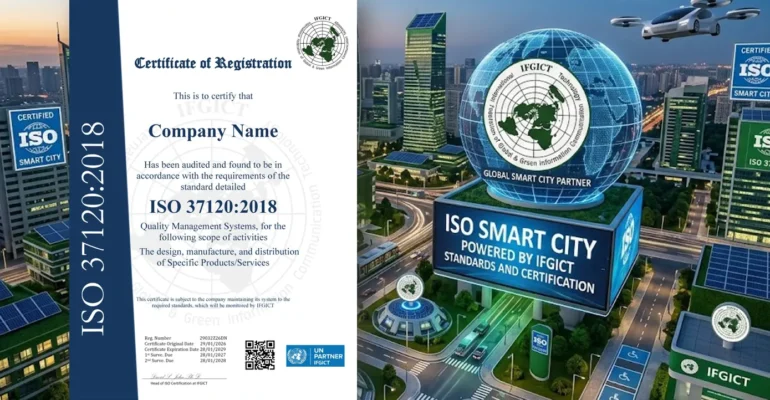
The Ultimate Guide to ISO Smart City Certification: How IFGICT Certification Empowers Sustainable Urban Transformation
Urban centers around the globe are facing an unprecedented influx of residents. This rapid expansion places immense pressure on existing infrastructure, public utilities, and governance models. To manage this growth sustainably, municipalities are shifting away from traditional urban planning toward data-driven, interconnected ecosystems known as smart cities.
However, building a smart city requires more than deploying disconnected IoT (Internet of Things) sensors or public Wi-Fi networks. It demands a structured framework that ensures interoperability, measurable performance, environmental sustainability, and long-term resilience. This is where international standards become critical.
As an independent, globally recognized organization, the IFGICT (International Federation of Green ICT) serves as a premier international standard audit and certification body. It provides specialized validation pathways for municipalities and technology vendors alike. Through rigorous third-party auditing, IFGICT offers comprehensive evaluation programs to verify that urban development strategies align with global benchmarks.
This deep-dive article explores how the IFGICT framework delivers structural auditing against the essential family of international urban standards—specifically ISO 37101, ISO 37122, ISO 37120, and ISO 37106—to foster smart, sustainable, and future-proof communities.
The Strategic Importance of Smart City Standardization
Without uniform benchmarks, urban tech deployments run the risk of becoming fragmented, siloed projects that fail to scale. Standardization offers a common vocabulary and set of performance indicators that allow local governments to gauge their progress against global peers, attract private investment, and protect public resources.
When a municipality pursues formal validation, it demonstrates a commitment to transparency and objective performance. Working with an experienced evaluation entity helps cities avoid vendor lock-in, streamline cross-departmental operations, and guarantee that technology deployments directly improve the quality of life for their citizens.
Decoding the Core Pillars of Urban Standardization
The international community has established a robust suite of standards to address different facets of urban evolution. These benchmarks span from high-level sustainable development management down to granular technical indicators for smart infrastructure.
ISO 37101: Sustainable Development in Communities
ISO 37101 serves as the overarching management system standard for sustainable development in communities. It establishes a platform that helps urban areas define their sustainability objectives and implement strategies to achieve them. Rather than focusing on a single technology, it outlines a holistic management strategy covering environmental, social, and economic goals.
ISO 37120: Indicators for City Services and Quality of Life
ISO 37120 defines a set of standardized indicators that measure the delivery of city services and overall quality of life. By tracking specific metrics across categories such as education, energy, health, transportation, and water, cities can generate reliable data to guide long-term budgeting and resource allocation.
ISO 37122: Indicators for Smart Cities
As an extension of ISO 37120, ISO 37122 introduces specialized indicators tailored specifically for smart cities. This standard focuses on the integration of advanced technologies within urban operations. It measures factors such as the deployment of real-time air quality monitoring systems, the percentage of public transit utilizing automated scheduling, and the implementation of smart grid technologies.
ISO 37106: Operating Guidance for Smart City Strategies
ISO 37106 provides a practical roadmap for managing smart city ecosystems. It offers operating guidance to help leaders navigate the structural, cultural, and technological shifts required to build open, collaborative, and digitally enabled urban spaces.
| Standard | Primary Focus | Practical Application |
| ISO 37101 | Sustainable Management Systems | Establishing holistic community development goals |
| ISO 37120 | Quality of Life Metrics | Benchmarking core city services (water, energy, education) |
| ISO 37122 | Smart Infrastructure Indicators | Measuring high-tech deployments (IoT, automation, smart grids) |
| ISO 37106 | Digital Operating Models | Providing governance and delivery roadmaps for smart strategies |
The Role of IFGICT as an Independent Certification Body
Unbiased verification is vital when evaluating complex, multi-million dollar urban initiatives. The IFGICT operates as an independent certification body, providing neutral, third-party assessments of city management frameworks and technical networks.
Through the IFGICT Smart City ISO Certification process, municipalities receive an objective, evidence-based review of their operational models. This structural independence prevents conflicts of interest and ensures that local governments receive a reliable blueprint of their strengths and operational gaps.
Why Independent Auditing Matters
- Objective Validation: Eliminates internal biases and confirms that public projects deliver genuine, measurable utility.
- Investor Confidence: Provides clear documentation of compliance, making cities more attractive candidates for international development grants and green bond financing.
- Risk Mitigation: Identifies data silos, interoperability issues, and security vulnerabilities before they impact public infrastructure.
Step-by-Step Implementation via the IFGICT Auditing Methodology
Achieving formal validation requires a systematic approach to verifying data integrity and operational alignment. The IFGICT leverages a structured auditing methodology designed to guide municipalities through assessment without disrupting day-to-day operations.
1. Gap Analysis and Baseline Assessment
The process begins with an in-depth review of the city’s current data architectures, management policies, and infrastructural assets. This stage highlights existing discrepancies between current operations and international benchmarks.
2. Documentation and Governance Alignment
Municipalities work to harmonize their administrative procedures, data-sharing protocols, and public policies with the target frameworks. This ensures that urban growth strategies are explicitly tied to documented, auditable management processes.
3. Technical Verification and Field Auditing
IFGICT lead auditors conduct thorough technical evaluations of the city’s active infrastructure. This involves validating the accuracy of data collection pipelines, assessing the interoperability of municipal software systems, and reviewing cybersecurity measures protecting citizen information.
4. Certification and Continuous Evaluation
Once a city demonstrates complete adherence to the criteria, it is awarded formal validation under the IFGICT Smart City ISO Certification program. To ensure that standards are maintained amidst ongoing technological and demographic shifts, certified entities undergo regular surveillance audits.
Real-World Value: Impact on Municipalities and Technology Vendors
Pursuing structural validation yields concrete advantages for all stakeholders involved in the smart city ecosystem.
For Municipalities and Public Administrators
- Optimized Budgets: Reliable performance metrics help city councils eliminate underperforming programs and direct funding to high-impact initiatives.
- Enhanced Interoperability: Breaking down operational silos allows data to flow smoothly between public safety, transit, and environmental departments.
- Civic Transparency: Standardized data reporting platforms allow citizens to monitor local sustainability achievements and service improvements directly.
For Technology Providers and System Integrators
- Market Differentiation: Vendors whose solutions match these international standards gain a clear competitive edge in public procurement processes.
- Streamlined Integration: Adhering to open, standardized parameters reduces the time and cost required to deploy hardware and software across diverse urban landscapes.
- Scalable Architectures: Developing products according to universally recognized frameworks makes it simpler to expand solutions into new municipal markets worldwide.
Integrating Green ICT with Smart City Architectures
A smart city cannot be truly sustainable if its underlying digital infrastructure consumes excessive energy or generates unsustainable electronic waste. The IFGICT emphasizes the cross-integration of Green ICT practices with modern urban planning.
This approach ensures that data centers, server networks, and edge-computing devices are engineered for maximum energy efficiency. By optimizing data routing, deploying energy-aware software solutions, and establishing strict e-waste lifecycle policies, cities can dramatically reduce the carbon footprint of their digital transformation efforts. This alignment directly supports the core mandates found within ISO 37101 and ISO 37122, blending digital intelligence with environmental responsibility.
Frequently Asked Questions (FAQ)
What is the primary role of IFGICT in smart city development?
The IFGICT acts as an independent, third-party standard audit and certification body. It evaluates and verifies that municipal strategies, infrastructure deployments, and digital systems conform strictly to international urban standards.
Is IFGICT an independent organization?
Yes, IFGICT is an independent ISO certification body. It operates neutrally to provide objective, unbiased verification and auditing services to public sector entities, private corporations, and technology vendors worldwide.
How do ISO 37120 and ISO 37122 differ from one another?
ISO 37120 establishes core indicators for general city services and overall quality of life across basic sectors like water, health, and education. ISO 37122 functions as a specialized extension that focuses directly on advanced technical indicators, smart automation, and digital infrastructure integration.
What are the steps to achieve an IFGICT Smart City ISO Certification?
The process entails a comprehensive four-stage path: an initial gap analysis to find baseline mismatches, documentation alignment to match governance standards, an independent technical audit of active infrastructure, and finally, formal certification accompanied by ongoing periodic reviews.
How can a city or technology vendor initiate the auditing process?
Organizations can begin the validation process by contacting the international support team directly via email at customerservice@ifgict.org to schedule an introductory consultation with a lead auditor.
Advancing Global Urban Resilience
As urban populations continue to climb, standardizing smart city architectures is no longer optional—it is a foundational requirement for stable, long-term development. Embracing frameworks like ISO 37101, ISO 37120, ISO 37122, and ISO 37106 provides local governments with the blueprints necessary to manage complex technical ecosystems sustainably.
Through independent validation under the IFGICT Smart City ISO Certification program, municipalities can confidently deploy scalable, secure, and energy-efficient systems. Partnering with an independent, dedicated certification body allows cities to turn ambitious digital visions into resilient, transparent realities that significantly improve the daily lives of their citizens.
To learn more about structural auditing programs or to begin a baseline assessment for your municipality, contact customerservice@ifgict.org.
References
- International Organization for Standardization. (2018). Sustainable leadership and development in communities — Management system for sustainable development — Requirements with guidance for use (ISO Standard No. 37101:2016). https://www.iso.org/standard/61885.html
- International Organization for Standardization. (2018). Sustainable cities and communities — Indicators for city services and quality of life (ISO Standard No. 37120:2018). https://www.iso.org/standard/68498.html
- International Organization for Standardization. (2019). Sustainable cities and communities — Indicators for smart cities (ISO Standard No. 37122:2019). https://www.iso.org/standard/69050.html
- International Organization for Standardization. (2018). Sustainable cities and communities — Operating guidance for smart city strategies (ISO Standard No. 37106:2018). https://www.iso.org/standard/69056.html
- International Federation of Green ICT. (2024). Smart City Evaluation Matrix and Independent Auditing Protocols. https://ifgict.org/iso-certification-body/