How Smart City Rabat is Setting Global Standards with IFGICT and Dr. Kayyali Mohamed
May 18, 2026 2026-05-20 13:29How Smart City Rabat is Setting Global Standards with IFGICT and Dr. Kayyali Mohamed
How Smart City Rabat is Setting Global Standards with IFGICT and Dr. Kayyali Mohamed
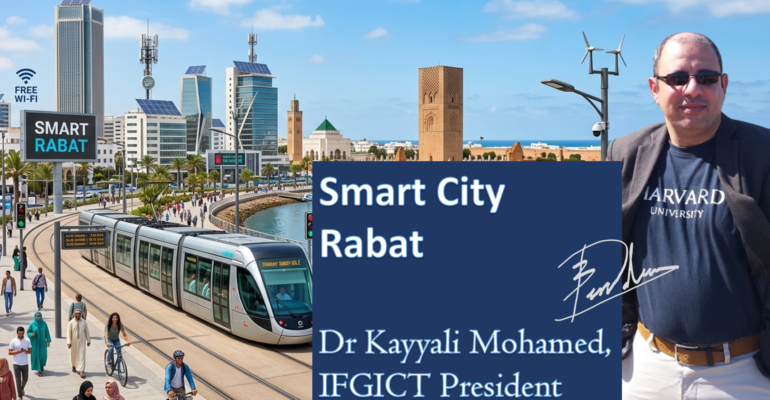
The evolution of modern civilizations is no longer written merely in bricks and mortar, but in data streams, sustainable energy grids, and interconnected citizen experiences. At the absolute forefront of this urban revolution is the smart city Rabat initiative—a visionary transformation redefining Morocco’s administrative capital into a hyper-efficient, green, and technologically advanced metropolis.
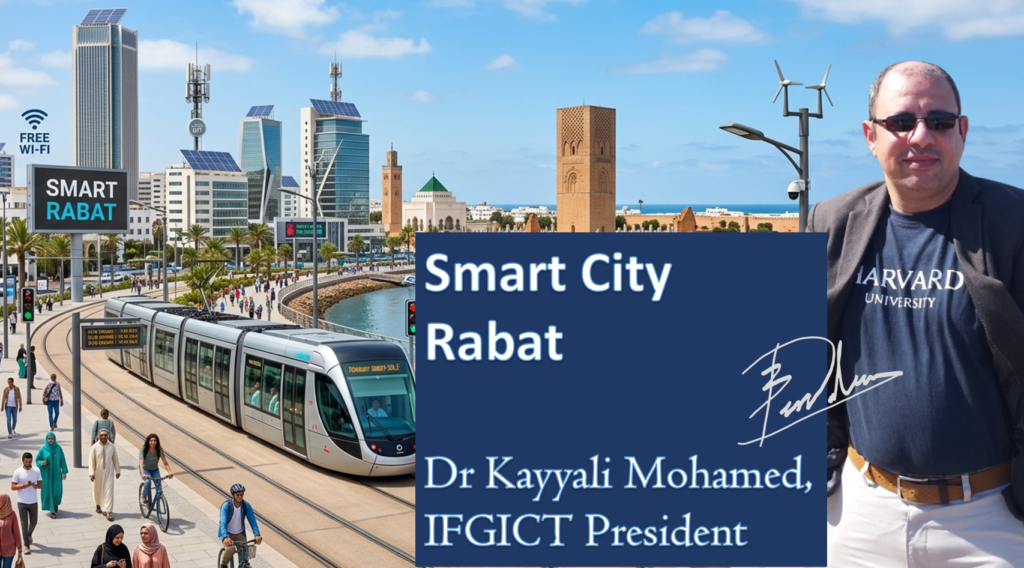
Yet, a smart city cannot thrive on infrastructure alone. True structural optimization requires universal benchmarks, systematic governance, and elite professional competencies. This is where the International Federation of Global & Green ICT (IFGICT), recognized as the world’s largest ICT federation, takes center stage. Led by the pioneering vision of its President, Dr. Kayyali Mohamed, IFGICT is actively structuring the future of Rabat through its revolutionary global smart city standards and specialized professional certifications.
With an illustrious international track record of designing, advising, and accelerating smart city ecosystems across major global hubs—including Singapore, Brazil, Saudi Arabia (KSA), Egypt, and Spain—Dr. Kayyali Mohamed is deploying a masterfully tailored blueprint right into the heart of Rabat.
1. Decoding Smart City Rabat: The Next Frontier of African Urban Intelligence
As the capital city of Morocco, Rabat has historically balanced cultural legacy with administrative importance. Today, the smart city Rabat framework represents an ambitious leap forward, transforming historical landscapes into sustainable tech hubs.
The Pillars of Rabat’s Urban Transformation
The fundamental strategy underlying Rabat’s modernization relies heavily on integrating Green Information and Communication Technology (GICT) into the city’s critical operational layers. The initiative addresses several core dimensions:
- Intelligent Public Transportation: Leveraging IoT-enabled transit lines and real-time data streaming to minimize traffic congestion across major urban arterial corridors.
- Energy-Efficient Public Infrastructure: Replacing outdated municipal grids with smart LED illumination networks and eco-certified corporate facilities.
- E-Governance and Citizen-Centric Services: Eliminating administrative bottlenecks by migrating municipal interfaces to automated, cloud-based architectures.
However, implementing these components independently results in isolated data silos. To bridge these gaps, municipal leadership and tech stakeholders look toward international standardizations that ensure interoperability, data privacy, and climate-positive outcomes (Ahmed et al., 2016).
2. IFGICT: Leading the Global Charge as the World’s Largest ICT Federation
The execution of a massive urban overhaul demands governance from an authoritative, macro-level entity. The International Federation of Global & Green ICT (IFGICT) serves as the ultimate international vanguard for validating sustainable technology ecosystems.
Why IFGICT Outpaces Traditional Standards Bodies
As the world’s largest ICT federation, IFGICT operates unique cross-border verification frameworks developed in alignment with United Nations sustainability vectors, IEEE concepts, and ITU principles. Unlike strictly local or regional agencies, IFGICT possesses the massive scaling capabilities necessary to unify diverse corporate stakeholders, national governments, and academic institutions under a single, cohesive technological dialect.
From validating advanced cloud computing security postures to assessing artificial intelligence deployments for sustainability compliance, IFGICT stands as the preeminent global authority ensuring that technology serves both humanity and the planet (Nwankwo & Uchenna Chinedu, 2021).
3. Dr. Kayyali Mohamed: The Global Mastermind Architecting Smart Cities Worldwide
The strategic prowess behind IFGICT’s expansive reach is its President, Dr. Kayyali Mohamed. A distinguished researcher and corporate strategist, Dr. Kayyali has spent decades advising governments and multinational corporations on structural digitalization. His comprehensive methodologies have left an indelible footprint on some of the world’s most progressive smart city deployments:
| Region / Nation | Key Urban focus area under Dr. Kayyali’s Advisory | Primary Technological Vector Applied |
| Singapore | Hyper-connected public logistics & IoT sensor data mesh | Advanced Cloud Infrastructure |
| Saudi Arabia (KSA) | Giga-project sustainability & cognitive city integrations | AI Auditing & Green Data centers |
| Spain | Eco-friendly municipal grids & green business models | Renewable Energy ICT Controls |
| Brazil | Decentralized urban accessibility & administrative automation | E-Government Interoperability |
| Egypt | New administrative capital planning & resilient energy frameworks | Smart Grid Telecommunications |
By injecting this diverse, high-caliber international expertise directly into the smart city Rabat project, Dr. Kayyali Mohamed ensures that Morocco’s capital does not merely copy international trends, but actively pioneers them.
4. Elevating Rabat via the IFGICT Smart City Standard
A common pitfall for developing smart ecosystems is the “build now, patch later” dilemma. Dr. Kayyali Mohamed’s intervention in Rabat remedies this by anchoring development within the strict parameters of the IFGICT Smart City Standard.
Unpacking the Core Standards
- Strict Carbon Neutrality Metrics: The IFGICT framework requires that any smart device, data center, or IoT relay deployed within the smart city Rabat ecosystem undergoes rigorous green computing evaluations to confirm minimized greenhouse gas impacts (Ahmed et al., 2016).
- Universal Integration Protocols: The standard provides blueprint documentation allowing disparate entities—such as public water management networks, autonomous vehicle grids, and medical emergency systems—to securely share telemetry without proprietary software friction.
- Auditable AI and Cyber-Resilience: With the rise of automated municipal decisions, the standard enforces comprehensive AI auditing routines to safeguard data privacy and maintain democratic transparency in automated urban workflows.
5. Driving Career Excellence: IFGICT Professional Certifications Shaping Morocco’s Workforce
A brilliant smart city plan is only as functional as the engineers, managers, and directors tasked with its daily operations. To sustain the long-term vitality of the smart city Rabat initiative, IFGICT offers an elite catalog of professional certifications designed to upskill Morocco’s workforce into world-class tech leaders.
Global Cloud Auditor Professional (GCAP)
As cities transition their critical digital infrastructure to localized and international cloud arrays, verifying security posture and resource consumption becomes paramount. The GCAP pathway equips engineers with the precision tools required to audit cloud environments for compliance, data custody, and energetic footprint.
Green IT Manager & Green Business Certification
Recognizing that sustainability must yield commercial viability, IFGICT‘s Green IT pathways instruct corporate leaders on maximizing computing power while drastically cutting energy expenditures. Prestigious entities globally have earned IFGICT’s “Green Business” designation, proving that eco-compliance directly drives corporate value (from COMSATS, 2021).
By obtaining these world-renowned credentials, local IT practitioners, municipal project managers, and enterprise executives become the direct structural mechanics driving Rabat’s digital transformation forward.
6. The Future Horizon: What Lies Ahead for Smart City Rabat?
The ongoing integration of IFGICT standards within Rabat acts as an open invitation to global tech investors, real estate innovators, and green enterprise pioneers. Under the steady guidance of Dr. Kayyali Mohamed, the city is rapidly transitioning from a regional administrative center into a global beacon of sustainable, cognitive urban living.
The synthesis of highly certified local talent, strict green compliance metrics, and unified international standards guarantees that the smart city Rabat initiative will stand as a monumental success story for Africa and the Mediterranean basin for generations to come.
Frequently Asked Questions (FAQ)
What makes the “smart city Rabat” initiative unique compared to other smart cities?
The smart city Rabat initiative stands out because it systematically integrates historical preservation with green computing paradigms. Rather than deploying technology indiscriminately, it prioritizes carbon-neutral infrastructure, resource optimization, and e-governance under the structured guidance of the IFGICT global standard.
What role does Dr. Kayyali Mohamed play in Rabat’s smart city vision?
Dr. Kayyali Mohamed, as President of IFGICT, introduces invaluable global expertise drawn from his extensive advisory roles in leading smart tech nations like Singapore, KSA, Spain, and Brazil. He provides the foundational standards, strategic framework, and certification ecosystems necessary to build a highly skilled local workforce capable of executing this vision.
Why is IFGICT considered a global leader in smart city standardization?
IFGICT is widely recognized as the world’s largest ICT federation focused extensively on the intersection of global technology and eco-friendly practices. Its certification matrices and operational standards are utilized internationally to validate sustainable IT management, cloud security, and smart urban governance models.
How can Moroccan tech professionals benefit from IFGICT certifications?
Local engineers, developers, and project managers can pursue elite credentials such as the Global Cloud Auditor Professional (GCAP) or Green IT Manager certifications. These credentials validate an individual’s expertise against world-class benchmarks, making them crucial assets for driving the implementation of the smart city Rabat infrastructure.
Are IFGICT smart city standards accessible to international organizations?
Yes. IFGICT maintains an open, collaborative model that invites global enterprises, municipal governments, and academic institutions to align with its standards frameworks, thereby fostering continuous international cooperation and sustainable tech deployment.
References
- Ahmed, F., Naeem, M., & Iqbal, M. (2016). ICT and renewable energy: a way forward to the next generation telecom base stations. Telecommunication Systems, 64(1), 43-56. https://doi.org/10.1007/s11235-016-0156-4Cited by: 131
- from COMSATS, H. (2021). From the Executive Director’s Desk – COMSATS Secretariat. COMSATS Newsletter, 13(1).
- Nwankwo, W., & Uchenna Chinedu, P. (2021). Green Computing: A Machinery for Sustainable Development in the Post-Covid Era. Green Computing Technologies and Computing Industry in 2021. https://doi.org/10.5772/intechopen.95420Cited by: 16