
Redefining the New Space Frontier: The New 12U CubeSat Structure Bus Frame by KSF Space
June 9, 2026 2026-06-09 15:16Redefining the New Space Frontier: The New 12U CubeSat Structure Bus Frame by KSF Space
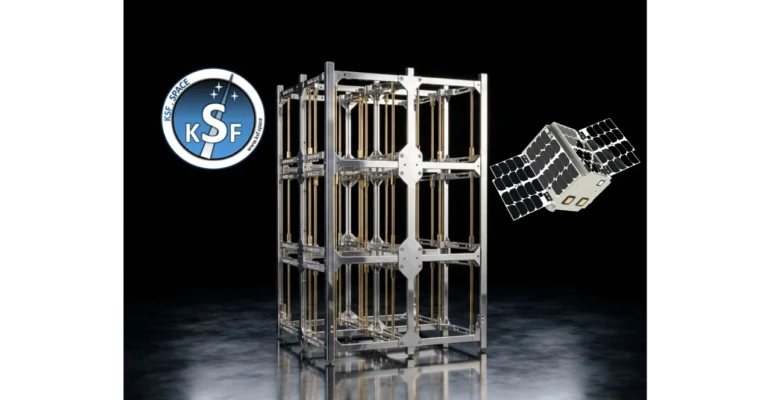
Redefining the New Space Frontier: The New 12U CubeSat Structure Bus Frame by KSF Space
The aerospace sector is undergoing a massive paradigm shift. High-budget, decades-long missions are no longer the exclusive gateway to Earth orbit and deep space. Instead, the “New Space” era is defined by agility, rapid prototyping, and highly cost-effective multi-satellite deployments. At the absolute epicenter of this revolution is the cubesat structure, the foundational skeleton that dictates a mission’s capacity, durability, and ultimate success.
For commercial constellation operators, Internet of Things (IoT) enterprise teams, and defense nanosatellite builders, choosing a structural platform is the most critical design decision. It cannot simply be a passive enclosure; it must be an engineered asset optimized for dynamic flight loads, payload volume customization, and structural longevity.
Addressing this modern demand head-on, KSF Space has engineered its next-generation 12U cubesat structure bus frame. This flight-ready architecture closes the gap between highly restrictive nanosatellites and heavy, cost-prohibitive microsatellites, delivering an optimized platform that arrives ready for your space mission.
The Evolution of the Satellite Frame: Moving from 1U to 24U Scalability
The modularity of the CubeSat design specification—originally established to give academic institutions affordable access to orbit—relies on standard dimensional blocks where a single unit (1U) equals a $10 \times 10 \times 10\text{ cm}$ cube. While a 1U, 2U, or 3U cubesat frame remains ideal for classic technology demonstrations, scientific experiments, and institutional training, commercial business models require significantly more power, volume, and payload capacity.
| Cubesat Frame Form Factor | Primary Application Profiles | Typical Payload Volume & Payload Restrictions |
| 1U / 2U / 3U | Educational outreach, localized sensor testing, low-data IoT demos. | Highly restricted; minimal space for dedicated propulsion or complex optics. |
| 6U | Regional Earth observation, tactical defense, intermediate IoT arrays. | Moderate payload space; can host compact sensors but forces major trade-offs in power and propulsion. |
| 12U | Global IoT constellations, heavy-duty commercial payloads, high-resolution optical/radar imagery, deep-space exploration. | Maximum volume-to-mass optimization. Safely accommodates massive battery arrays, deployable solar arrays, and deep-space electric propulsion. |
| 18U / 24U | High-throughput communications, inter-satellite laser links, complex scientific payloads. | Heavy-duty platforms bordering on microsatellite performance; long manufacturing lead times. |
As the industry migrates toward advanced constellations, the 6U and 12U configurations have stepped forward as the definitive professional standards. However, the new 12U cubesat structure bus frame engineered by KSF Space represents a massive leap forward. By utilizing a configuration that stacks components side by side, it unlocks unprecedented configuration layouts, transforming a simple satellite frame into an adaptive, heavy-duty bus ready to survive the hostile environment of space.
Behind the Engineering: Designing a Resilient Cubesat Structure
A high-performance cubesat structure is far more than a simple metallic box. It is a highly sophisticated piece of aerospace engineering that serves as the primary shield for sensitive internal electronics, payload sensors, and onboard computers against the violent acoustic and mechanical vibrations experienced during launch vehicle liftoff. Furthermore, once in orbit, the cubesat frame must continuously withstand severe thermal cycling—swinging wildly from extreme solar radiation heat to the absolute cold of Earth’s shadow.
Premium Material Selection for Aerospace Longevity
To guarantee structural rigidity while keeping the overall dry mass to an absolute minimum, KSF Space manufactures its modular buses and structures using premium, space-qualified aerospace-grade aluminum alloys (such as Aluminum 6061-T6 or 7075). These specific material configurations provide critical operational benefits:
- Ultra-Low Outgassing: Materials are meticulously treated and finished to guarantee that they will not release volatile gases when exposed to a high-vacuum environment. This eliminates the risk of outgassed molecules condensing onto sensitive payload optics, star trackers, or laser communication lenses.
- Superior Thermal Conductivity: The metal composition acts as a highly efficient, passive thermal bus. It helps dissipate heat generated by dense internal printed circuit board (PCB) stacks, high-performance edge-computing AI chips, and internal power distribution systems out toward the external radiation panels.
- Precision CNC Machining: Every single rail on the KSF Space 12U structure undergoes precision machining and hard-anodization. The exterior interfaces are perfectly smooth, ensuring the satellite slides out of canister-style deployment systems safely and smoothly without any risk of binding or snagging.
Dispenser Compliance and Mechanical Integration
When launching a spacecraft, compliance with strict launch vehicle dispenser specifications is non-negotiable. The 12U cubesat structure by KSF Space is fully compliant with the major industry-standard deployers and launch integration hardware. Fitted with stainless steel threaded inserts to prevent material galling, the design includes customizable internal secondary structures and multiple integrated mechanical kill switches to isolate battery power safely until the moment of orbital deployment.
Unlocking New Orbital Business Models for Constellations and IoT
For commercial enterprises deploying small satellite arrays, the architecture of the satellite frame directly influences your company’s return on investment (ROI). The KSF Space 12U platform is purposefully designed to address the specific needs of fast-growing aerospace sub-sectors.
High-Throughput IoT Satellite Companies
Internet of Things (IoT) space networks demand continuous, uninterrupted coverage, highly efficient low-power transceivers, and robust data routing. The KSF Space 12U cubesat structure offers ample volume to house multi-band antenna systems alongside complex software-defined radios (SDRs). The increased physical footprint means your engineers can integrate large internal battery modules and complex deployable solar panels, generating the necessary power margins to handle continuous data downlinks from millions of ground-based IoT sensors without thermal throttling.
Advanced Cubesat Constellation Operators
Building a scalable satellite constellation requires manufacturing predictability, rapid system integration, and interoperability. Because KSF Space manages an array of standardized, flight-proven structural kits spanning from 1U, 2U, 3U, to 6U, 12U, 18U, and 24U, constellation companies can seamlessly scale their payload designs up or down without entirely redesigns of their core avionics architecture. The platform approach significantly minimizes non-recurring engineering (NRE) costs and aggressively shortens lead times, moving hardware from the assembly floor to the launch pad in record time.
High-Capability Nanosatellite Builders
Modern payloads—such as hyperspectral optical sensors, synthetic aperture radar (SAR), and tactical defense communication suites—demand physical space and absolute structural alignment. The 12U cubesat frame splits its internal volume strategically, dedicating up to 8U–9U of entirely unencumbered space for payloads, while dedicating the remaining volume to core bus avionics, momentum reaction wheels, and integrated electric chemical or ion propulsion systems. This allows nanosatellite builders to achieve performance metrics that previously required traditional microsatellites weighing over 50 kilograms.
The KSF Space Integration and Qualification Workflow
When you source a structural platform from KSF Space, you are investing in an extensive ecosystem backed by years of deep aerospace flight heritage. Every single cubesat structure is built to withstand the rigorous Verification and Validation (V&V) protocols required by global launch providers.
1. Mission Profile and Custom Configuration
Every space mission features unique physical layouts. Whether you are integrating a custom PC104-compliant board stack, alternative internal brackets, or unique exterior mounting cutouts for fine sun sensors and star trackers, KSF Space provides customizable manufacturing options. This ensures your satellite frame arrives customized specifically to your internal hardware blueprints.
2. Assembly, Integration, and Testing (AIV) Support
A structural frame must undergo aggressive environmental simulation testing to secure flight manifest approval. The KSF Space engineering philosophy guarantees that our structures are fully qualified to survive:
- Thermal Vacuum (TVAC) Testing: Validating structural integrity and outgassing characteristics across intense temperature swings in an airless environment.
- Vibration and Acoustic Testing: Exposing the fully integrated structure to random vibration profiles, sine sweeps, and high-G mechanical shocks to simulate rocket launch profiles.
- Electromagnetic Compatibility (EMC): Making sure the structural shielding works harmoniously with high-power internal communication buses and RF components.
3. Flight-Proven Hardware Delivery
With an exceptional track record of orbital deployments and deep technical references across the international aerospace landscape, KSF Space ensures your team bypasses structural integration complications. When the hardware lands in your cleanroom, it is fully ready to be integrated with your flight avionics and payload subsystems immediately.
Secure Your Orbital Mission Success Today
The global space race waits for no one. Whether your team is actively finalizing a tactical IoT constellation deployment, prototyping an advanced earth observation payload, or designing a high-power deep space demonstration mission, your choice of structural architecture determines your limits.
Do not allow restrictive, fragile, or generic components to introduce risk to your mission or delay your launch timeline. Partner with an industry leader that delivers unmatched customization options, high-grade materials, and extensive flight heritage.
Ready to configure your next satellite bus? Bring your specific mission parameters, structural layout requests, and payload dimensions to our engineering team. Contact KSF Space directly via email at info@ksf.space to download comprehensive CAD models, request technical datasheets, or secure an official quotation for your upcoming orbital mission.
Frequently Asked Questions (FAQ)
What are the precise dimensions and weight profiles of the new 12U cubesat structure?
The KSF Space 12U structure standardizes on outer envelope constraints compatible with modern containerized orbital deployers, typically measuring approximately $226.3 \times 226.3 \times 366\text{ mm}$ (or variations depending on specific deployer rail standards). The exact structural dry mass depends on your custom configuration and choice of interior bracketry, but our optimized aluminum architecture is engineered to provide the highest rigidity-to-mass ratio available, ensuring maximum mass allocation remains available for your payload.
Can the internal layout of the 12U satellite frame be customized for non-standard payloads?
Yes, absolutely. While the cubesat structure natively supports standard PC104 board configurations and multi-unit vertical or horizontal stacks, KSF Space specializes in customized structure services. We can easily adapt internal mounting patterns, modify secondary structural walls, and create custom external panel windows to accommodate unique camera lenses, laser windows, thruster nozzles, or deployable antenna mechanisms.
Does KSF Space offer structural kits across other form factors besides 12U?
Yes. KSF Space manufactures a comprehensive lineup of modular space structures tailored to meet any mission scale. Our product portfolio includes standard configurations for 1U, 2U, and 3U structures for localized payloads, as well as heavy-duty professional architectures including 6U, 12U, 18U, and 24U frames designed specifically for commercial satellite constellations and deep space exploration.
Is the 12U cubesat frame flight-proven?
Yes. KSF Space hardware carries extensive flight references. Our structures and engineering designs have been deployed and successfully validated in the actual, harsh vacuum environment of space. This extensive flight heritage minimizes your overall mission risk profile and drastically simplifies the launch qualification process with international launch providers.