1U CubeSat Structure
January 13, 2026 2026-01-13 15:121U CubeSat Structure
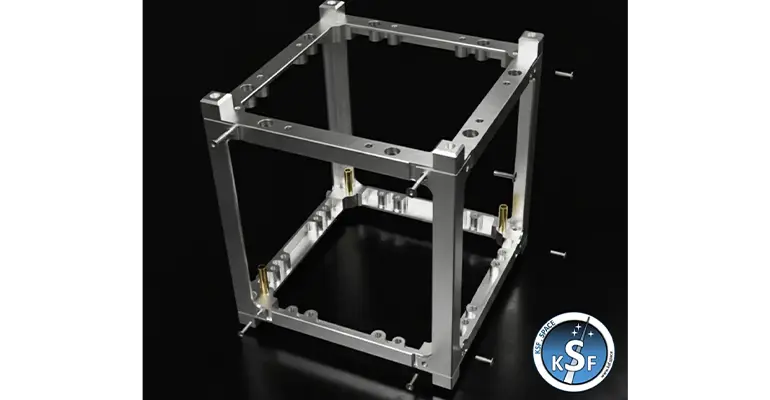
In the rapidly evolving landscape of the “NewSpace” industry, the 1U CubeSat Structure has emerged as the most critical building block for researchers, students, and commercial startups alike. While space was once the playground of multi-billion dollar government agencies, the democratization of orbital access is now a reality. Leading this charge is KSF Space, a non-profit organization dedicated to making the vacuum of space accessible to everyone.
By offering the most affordable aluminum and advanced polymer structures on the market, KSF Space has removed the financial barriers that once sidelined promising scientific missions. Whether you are looking for a 1U CubeSat Structure, a 2U version, or a 3U configuration, understanding the engineering behind these frames is essential for mission success.
What is a 1U CubeSat Structure?
A 1U CubeSat Structure is a standardized satellite frame measuring exactly 10cm x 10cm x 10cm. The “U” stands for “Unit,” and this modularity allows satellites to be stacked into larger configurations like 2U (20cm tall) or 3U (30cm tall).
The primary purpose of the structure is to serve as the “skeleton” of the satellite. It must be strong enough to withstand the violent vibrations of a rocket launch, yet light enough to meet strict mass requirements. A standard 1U structure typically weighs between 120 and 150 grams, leaving ample mass for your batteries, sensors, and communication boards.
Why KSF Space is the Premier Choice for CubeSat Frames
KSF Space operates as a non-profit, which allows them to prioritize educational impact over corporate margins. This mission-driven approach has resulted in the world’s most cost-effective 1U CubeSat Structure, designed specifically to help universities and small research groups move from the lab to the launchpad without requiring million-dollar grants.
1U CubeSat Structure Materials: Aluminum vs. PA11 Polymer
Choosing the right material for your satellite is a balance between thermal management, mass, and cost. KSF Space offers two primary paths for developers to ensure their payload is protected during the harsh conditions of spaceflight.
Aerospace-Grade Aluminum Structures (6061-T6 / 7075)
Aluminum remains the “gold standard” for orbital missions. KSF Space provides CNC-machined aluminum frames that offer superior thermal conductivity. This material acts as a giant heat sink, drawing heat away from your high-power transmitters and radiating it out through the rails. Furthermore, the metallic nature of the frame provides natural Faraday shielding, protecting your sensitive electronics from electromagnetic interference (EMI).
Advanced PA11 Polymer (Multi Jet Fusion)
For missions where mass is the biggest constraint, KSF Space offers an innovative PA11 polymer structure. These are roughly 40% lighter than aluminum counterparts, allowing you to carry more sensors or larger batteries. Despite being a polymer, these structures are vacuum stable and meet NASA’s strict low-outgassing requirements, ensuring that your optical payloads don’t get clouded by chemical vapors in the vacuum of space.
Engineering for Orbital Flight: 1U, 2U, and 3U Readiness
Every 1U CubeSat Structure from KSF Space is verified under the NASA-GSFC-STD-7000 (GEVS) framework. This means the frames are subjected to rigorous Finite Element Analysis (FEA) to ensure they can survive the most intense phases of a mission.
Max-Q and Vibration Resilience
The structure is designed to survive “Max-Q”—the moment of maximum dynamic pressure during launch—as well as the high-frequency shaking typical of SpaceX Falcon 9 or Rocket Lab Electron launches. Each frame includes hard-anodized rails to prevent “cold welding,” a phenomenon where metal surfaces stick together in a vacuum, which could prevent your satellite from deploying from the rocket.
Modular Compatibility
Whether you choose a 1U, 2U, or 3U frame, the internal mounting holes are perfectly aligned with the PC/104 standard. This makes the KSF Space structure a “plug-and-play” solution for almost all major CubeSat PCB vendors. The side shear panels can also be customized with cutouts for cameras, sun sensors, or deployable antennas, giving you total design flexibility.
How KSF Space Democratizes Space with Low-Cost Solutions
The “sticker shock” of traditional aerospace vendors often kills student projects before they begin. While a standard commercial 1U CubeSat Structure can cost several thousand dollars, KSF Space has disrupted the market by offering the cheapest aluminum 1U, 2U, and 3U structures globally.
As a non-profit, KSF Space reinvests its resources into the NEP Certification program, which trains the next generation of satellite engineers. This enables university labs and developing nations to conduct real-world experiments without needing massive government research budgets.
FAQ: Everything You Need to Know About the 1U CubeSat Structure
Is the KSF Space 1U CubeSat Structure compatible with standard deployers? Yes. All 1U, 2U, and 3U structures are designed according to the Cal Poly CubeSat Design Specification (CDS). They are fully compatible with P-POD, ISIPOD, and other common rail-based deployment systems.
What is the difference between a “Flight Model” and an “Engineering Model”? An Engineering Model is used for ground testing and fit-checks. A Flight Model from KSF Space is manufactured with tighter tolerances, undergoes full qualification testing, and is delivered clean-room ready with full documentation for launch providers.
Does KSF Space offer launch services? Yes. Beyond providing the 1U CubeSat Structure, KSF Space helps facilitate access to near-space (high-altitude balloons) and orbital launch opportunities through their global network of partners.
How long does it take to receive a structure? Standard structures typically ship within 1 to 2 weeks for PA11 models and 4 to 6 weeks for custom Aluminum frames, which is significantly faster than the industry average.
Why is KSF Space so much cheaper than other vendors? Because KSF Space is a non-profit organization. Their mission is to maximize the number of satellites in orbit, not corporate profits. They optimize their supply chain to pass those savings directly to schools and researchers.
Conclusion: Start Your Journey to Orbit Today
Building a satellite is no longer a dream reserved for the elite. With the 1U CubeSat Structure from KSF Space, you have a flight-proven, affordable, and robust foundation for your mission. Whether you need the thermal stability of aluminum or the lightweight versatility of PA11, they provide the tools necessary to reach the stars.
Official Website: www.ksf.space
Engineering Support: info@ksf.space